

Key takeaways:
- A permit expediter is a professional who helps prepare, submit, and manage building permit applications.
- Permit expediters typically cost anywhere from $500 to $15,000+ depending on project complexity and location.
- Permit expediters can be expensive, hard to scale, and dependent on individual availability, making them less ideal for teams managing multiple permits.
- Permit management software is the best alternative to a permit expediter because it helps you standardize, track, and scale permitting across projects with greater visibility and control.
Navigating the building permit application process is nothing short of a headache. Every jurisdiction has its own unique rules and procedures, which means the permitting process can take forever. And not only that, but permitting can throw off your schedule, impact your cash flow, and increase your project timelines (and therefore your time to revenue).
Working with a permit expediter is one way to speed up that painstaking process and take the extra work off your plate. But it’s not your only option.
What you’ll learn:
- What a permit expediter is
- What permit expediters do
- The cost of a permit expediter
- Whether you need a permit expediter
- What to consider before hiring a permit expediter
- What to look for when hiring a permit expediter
- Permit expediter alternatives worth considering
Less work. Faster builds. Increased revenue. All possible with PermitFlow. Learn more.
What is a permit expediter?
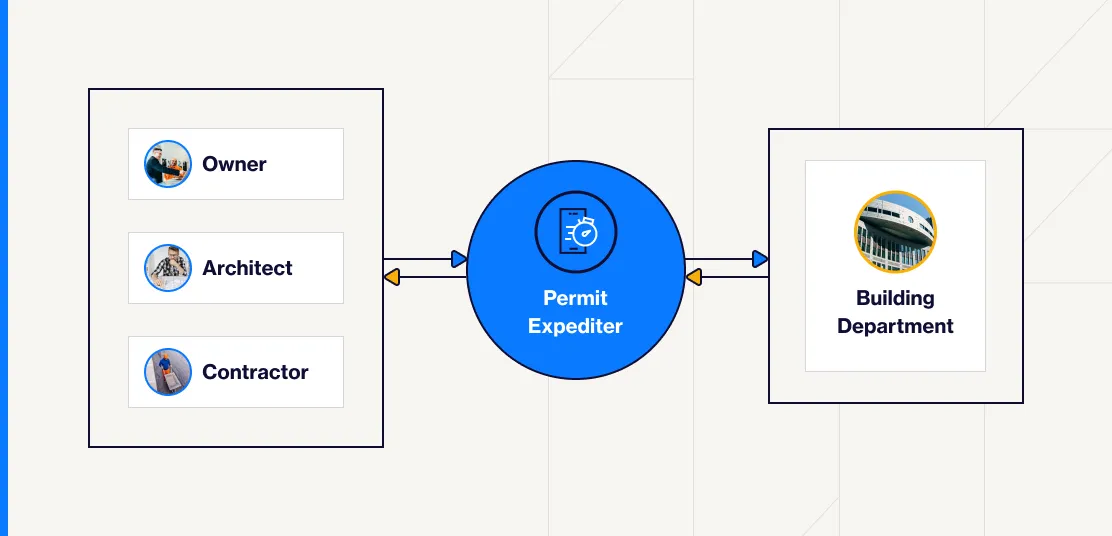
A permit expediter is someone who helps you obtain a building permit and navigate the permit process from start to finish. They act as a guide through the fragmented and highly localized permitting process, where requirements, timelines, and submission processes vary by city, county, and agency.
A permit expediter may help reduce the risk of delays caused by incomplete applications, incorrect documentation, or misunderstandings of local requirements. Instead of learning each jurisdiction’s process yourself, you rely on someone who already understands how approvals typically move through that system.
Experienced permit expediters can shorten the time it takes for a permit to be reviewed and approved by helping you avoid common pitfalls early. This can make a meaningful difference in keeping your project timeline intact and getting to construction faster.
Experienced permit expediters will reduce the amount of time it takes for your building permit application to be processed and approved. As a result, you’ll be able to start your project sooner.
An experienced permit expediter has:
- A solid understanding of local building codes and permit requirements
- Familiarity with how specific jurisdictions review and process permit submissions
- Connections with local professionals and building department officials who oversee permitting
- Specialization in obtaining permits for the type of project you bring them, whether residential, commercial, or trade-specific
What is a permit runner?
A permit runner is essentially the same thing as a permit expediter — someone who helps you prepare and submit a building permit application.
However, some may define the role of a permit runner as focused solely or primarily on the actual application submittal process, while a permit expediter has the extensive local knowledge of how to most efficiently navigate the permitting process in a given jurisdiction.
Permit runners often work solo operating their own expediting business, but some work as employees at construction companies.
What does a permit expediter do?
A building permit expediter’s job is to prepare, submit, and track your building or construction permit application so it moves through the approval process without unnecessary delays. They’re typically brought in to handle the administrative side of permitting, especially for teams that don’t have the time or in-house expertise to manage it themselves.
Ultimately, they take the legwork of applying for a permit off your plate.
A permit expediter’s services typically include:
- Researching local requirements
Every jurisdiction has its own rules, submittal formats, and review processes. An expediter will identify exactly what’s required for your specific project so you’re not guessing or working off outdated information. - Reviewing plans before submission
Before anything gets submitted, they’ll review your drawings and documentation against local codes and requirements. The goal is to catch issues early to avoid rejections and revision cycles. - Preparing and submitting the application
Permit expediters handle the paperwork, assemble the full permit package, and submit it through the appropriate channel, whether that’s an online portal or in person. - Coordinating with the building department
Once submitted, the permit expediter acts as the point of contact with the city or county. That includes answering plan check comments, relaying feedback to your team, and helping move the application forward. - Managing revisions and resubmissions
Quite often, permits don’t get approved on the first pass. Expediters help interpret comments from reviewers, coordinate updates with your architect or engineer, and resubmit corrected plans. - Tracking submission status and keeping things moving
Instead of your team calling or emailing the AHJ for updates, the expediter monitors progress and follows up as needed to prevent applications from sitting idle.
Do I need a permit expediter?
No, you aren’t required to work with a permit expediter. Many contractors and builders handle permitting in-house, especially for straightforward projects in jurisdictions they know well.
However, hiring an expediter is one way to save time and keep your project on-schedule.
That said, whether you should use one depends on how complex your project is, how familiar your team is with the local process, and how much time you can realistically dedicate to managing permits.
A permit expediter can make sense if:
- You’re building in a new city or jurisdiction
Every AHJ has its own process, forms, and expectations. If your team isn’t familiar with the local requirements, the learning curve alone can slow you down. - Your project involves multiple approvals
Projects that require zoning reviews, plan checks, or sign-offs from multiple departments tend to create more back-and-forth. An expediter can help coordinate across those touchpoints. - You’re managing a high volume of permits
If you’re pulling permits across multiple jobs or markets at the same time, the administrative workload adds up quickly. Keeping everything organized, submitted, and moving forward becomes a job in itself. - Your team is already stretched thin
Between research, paperwork, follow-ups, and revisions, permitting takes a lot of time. If your PMs or ops team are juggling multiple responsibilities, permitting can easily fall behind. - Delays would materially impact your timeline or revenue
If getting to construction quickly is critical, avoiding preventable delays becomes more important. Even small mistakes in a permit submission can push timelines out by weeks.
On the other hand, you may not need a permit expediter if you’re working on a simple project in a jurisdiction your team knows well, with a clear and predictable approval process.
The key question is less about whether you can handle permitting yourself and more about whether it’s the best use of your resources.
Tip: If you’re going to hire a construction permit expediter, bring them on as early as possible in the project. That way, they can anticipate and prevent potential problems.
How much does a permit expediter cost?
There is no set price or flat rate for permitting services. The cost of permit expediting services depends on the type of project, the jurisdiction, and how much work is required to get your permit approved.
Most permit expediters bill in one of three ways:
- Hourly rates, typically for smaller or undefined scopes
- Flat project fees, common for standard permits without significant complexity
- Hybrid pricing, a base fee plus hourly charges for revisions or additional work
Tip: Make sure you get a quote from a prospective expediter before hiring them. Their quote will account for how much work your project requires based on your jurisdiction’s requirements.
Typical costs of permit expediting services
While pricing varies by market, here’s a general sense of what contractors and builders can expect:
- Simple residential permits: $500 – $2,000
- Moderate projects: $2,000 – $6,000
- Complex commercial projects: $5,000 – $15,000+
Permit expediters who charge an hourly rate tend to charge between $30 - $100 per hour.
What you’re actually paying for
- Upfront research and due diligence
Reviewing local codes, identifying required permits, and mapping out the submission process - Application preparation and submittal
Assembling forms, organizing documentation, and submitting through the correct channels - Plan review coordination
Managing communication with plan reviewers, responding to comments, and coordinating updates with your design team - Revisions and resubmissions
Each correction cycle adds time and cost, especially if plans need multiple updates - Status tracking and follow-ups
Checking permit status, following up with departments, and keeping the application moving
Factors that impact permit expediter costs
Two projects that look similar on paper can have very different expediting costs. The biggest variables include:
- AHJ complexity
Some cities have straightforward processes, while others require multiple departments, in-person visits, or specific sequencing - Project scope and type
Ground-up construction, change-of-use, and projects requiring zoning approvals typically cost more than simple trade permits - Quality of your initial submission
Incomplete or inconsistent plans lead to more revisions, which increases both time and cost - Number of permits required
Projects that require separate permits (building, electrical, plumbing, mechanical, etc.) increase the overall workload and therefore the cost - Timeline expectations
Expedited or rush requests tend to come with additional fees
Hidden costs to watch for
- Extra revision cycles beyond what was originally scoped
- Additional permits discovered mid-process
- Scope changes that require new submissions
- Time spent coordinating across multiple stakeholders
Benefits & drawbacks of permit expediters
Potential benefits:
- Local knowledge
There’s a good chance you don’t know all the ins and outs of the local ordinances in every city where you build. And it would be a waste of your time to spend hours familiarizing yourself with them. Working with a permit expediter gives you immediate access to a wealth of specialized knowledge about the city, its laws, and its processes. Plus, many building permit expediters also have relationships with government officials and department employees, which can improve your chances of approval and speed up the process.
- Save time
Permit expediters may be able to help you get your permit in hand faster. This will empower you to start work on the project faster, which saves you money in the long run. You’ll also have more time to focus on the other aspects of your project.
- Take work off your plate
Hiring a permit expediter lets you take some of the tedious and time-consuming work of permitting off your own plate. By partnering with an expediter, you won’t have to tackle difficult tasks like researching permitting requirements, preparing permit paperwork, and handling back-and-forth communication with the AHJ.
Drawbacks
- Unnecessary for certain projects
Simple, straightforward projects — especially in smaller jurisdictions — may not actually require the services of a permit expediter. For smaller projects, hiring an expediter could be overkill.
For example, projects in small municipalities likely have simpler permitting processes that don’t actually require extensive work on your part. So in these cases, it may be smarter to save your money and just handle the permit application process internally. - Added cost
Plain and simple, hiring a permit expediter adds an extra expense to your project. In some cases — particularly straightforward projects in smaller towns — the ROI of hiring a permit expediter may not actually pay off. - Lack of expertise
Many permit expediter services are an add-on feature for a business that focuses primarily on other services. As a result, permit expediters who work for larger companies may actually lack the deep knowledge and expertise needed to tackle your unique project.
Besides building permits, they might also handle contractor licensing, noise variances, street vendor spaces, and traffic permits/approvals. Since each of these services has unique forms, rules, and timelines to follow, the chances of finding a true permit expediter amid all these other services are slim.
What’s more, permit expediting is often assigned to junior employees who may lack the experience needed to get your building permit issued as quickly as possible. - Limited service area
Many permit expediters only work on projects within a certain geographic area. So, for example, a certain company could easily file all your San Francisco permits but wouldn’t be able to handle a project down the freeway in Brisbane or Daly City.
This scenario can be especially problematic for many residential and commercial contractors, as their services typically cover several cities, counties, and jurisdictions. - Employee overwhelm
When hiring an expediter, you have to be mindful of their schedule beyond your project.
New expediters can easily lose or misfile information until they become familiar with new software or programs. And overworked expediters can become so busy playing catch-up that they submit an incomplete building permit application package and delay the entire process.
Alternatively, a busy expediter may get swamped with new projects and drop the ball on your application. They might fail to contact you regarding building department feedback, needed corrections, or clarifications — and then you’ll be stuck chasing them down for updates.
What to consider before hiring a permit expediter
Hiring a permit expediter can be helpful in certain situations, but it’s not always the best fit for every project or team. Before bringing one on, it’s worth understanding where they add value and where they can fall short.
Here are a few key factors to think through:
How complex is your project, and where are you building?
Permit expediters tend to be most useful in jurisdictions with complicated processes or for projects that require multiple approvals across departments.
If you’re working in a city with layered requirements (zoning, planning, fire, public works), having someone who understands how those pieces fit together can help reduce friction.
But for straightforward projects or for teams working repeatedly in the same jurisdictions, the added cost of an expediter may not always justify the benefit, especially if the process can be standardized.
How much time can your team realistically dedicate to permitting?
Permitting isn’t a one-time task. It requires ongoing coordination that can easily take hours each week. If your team doesn’t have the bandwidth, an expediter can step in to manage that work.
But those aren’t the only two options. Many teams today are looking for ways to streamline permitting workflows altogether, reducing manual work rather than outsourcing it project by project.
Are you relying on one person or a scalable process?
Most permit expediters operate as individuals or small teams. That can work well for a single project, but it gets harder to manage as your workload grows.
If you’re running multiple jobs across multiple jurisdictions, everything depends on that person’s availability. When they get busy, things can slow down — follow-ups take longer, resubmissions get delayed, and timelines start to slip.
So, the question becomes: Is permitting something you can scale, or something that’s always limited by one person’s bandwidth?
How experienced is the person actually handling your permit?
In some cases, expediting is just one of many services a business offers. Or, it’s possible the work will be handled by junior staff or generalists.
That can create gaps in expertise, especially in jurisdictions with nuanced requirements. It’s worth confirming who will actually manage your permit and how familiar they are with your specific project type and location.
What’s the true cost beyond the initial quote?
Hiring a permit expediter adds a direct cost, but there are often indirect costs as well.
Additional revision cycles, scope changes, or coordination across multiple permits can increase the total cost over time. And because expediters are typically scoped per project, costs can scale quickly if you’re managing multiple jobs at once.
In some cases, the bigger cost isn’t just the fee but the lack of consistency from one project to the next.
How much visibility and control do you need?
With a permit expediter, much of the process is handled externally. That can save time, but it can also limit your visibility into where things stand at any given moment.
If you’re managing multiple projects or tight timelines, relying on updates from a third party can make it harder to stay proactive. Delays aren’t always obvious until they’ve already impacted your schedule.
What to look for when hiring a permit expediter
If you’ve decided to hire a permit expediter, don’t just go for the first person you come across. Do your due diligence to ensure you’re hiring the best one.
Here’s what to look for when hiring an expediter:
- Make sure they’re knowledgeable about the city or county's processes. Working with an expediter who understands the jurisdiction’s unique policies and procedures increases the chances of the process going smoothly.
- Choose someone with the right specialties. For example, if you need a permit to build a residential home, choose a residential permit expediter who has experience with that industry.
- Work with someone who scopes the project at the start. Choose an expediter who will do their due diligence right away and provide you with a report on how long the process will take, which applications you’ll need, and how much it’ll cost to obtain the permit.
Permit expediter alternatives
Hiring a permit expediter isn’t your only option. The right choice comes down to how much control, consistency, and scalability you need.
Most teams that don’t hire an expediter choose one of two options:
1. Use permitting management software
Permit management software is designed to make permitting a structured, repeatable workflow instead of a manual, project-by-project task.
Instead of relying on internal employees or a third party, permit management software handles the full lifecycle of a permit from research and application preparation to submission, tracking, and approval.
With permit management software, you can:
- Centralize all your permits in one place instead of tracking them across emails, spreadsheets, and multiple portals
- Standardize submissions so applications are complete and consistent across projects
- Track status in real time without chasing updates from AHJs
- Reduce back-and-forth by catching issues earlier in the process
- Scale across multiple projects and markets without increasing headcount or administrative overhead
Rather than treating permitting as a one-off task, using software turns permitting into a streamlined process that supports your entire pipeline.
2. Handle permitting in-house
Some contractors and builders manage permits internally, especially if they frequently work in the same jurisdictions and have experience with local requirements.
Handling permitting in-house gives you full control over the process and avoids external fees. But it also means your team is responsible for everything: researching permit requirements, preparing submissions, coordinating revisions, and following up with the city.
Even for a small workload, that can be time-consuming. And as volume increases, permitting gets even more fragmented across inboxes, spreadsheets, and different team members, making it harder to keep everything moving.
Use PermitFlow instead of a permit expediter
Permit expediters can help move a single project forward. But for teams juggling projects across multiple jurisdictions, the challenge is bigger than just getting one permit approved. You need a solution to manage the entire permitting process across your pipeline.
That’s where PermitFlow is different.
Instead of relying on a person to handle permits one at a time, PermitFlow gives you a structured, end-to-end permitting process that scales with your business.
With PermitFlow, you get:
- End-to-end permit management
PermitFlow handles the full permitting lifecycle from upfront research and application preparation to submission, tracking, and final approval. Your team doesn’t have to piece together requirements, chase down updates, or manage back-and-forth with different departments. It’s all handled in one coordinated workflow, in one convenient dashboard. - A standardized, repeatable process
Every permit follows a consistent process, regardless of location or project type. That means fewer errors, fewer revision cycles, and fewer surprises. Instead of reinventing the process for each job, your team operates with a system that’s built to scale. - Real-time visibility across all permits
No more digging through emails or logging into multiple city portals. With PermitFlow, you can see the status of every permit across every project in one place. View at-a-glance what’s submitted, what’s under review, and what needs attention. - Built for teams managing volume
Whether you’re operating in one city or across multiple states, PermitFlow is designed to support high permit volume. You’re not limited by one person’s bandwidth or service area. As your pipeline grows, your permitting process scales with it. - Expertise built into the process
PermitFlow combines software with a team of permitting experts — including architects, engineers, and former city planners — who ensure submissions are accurate and aligned with local requirements. Instead of relying on ad hoc knowledge, that expertise is embedded into every step of the process.
Get a demo to see how PermitFlow can save you time and grow revenue.